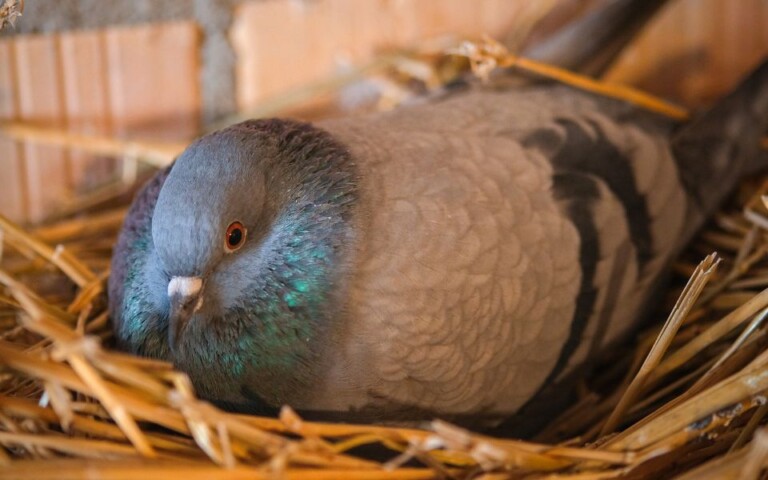
Humane Population Management
Egg Swapping for
Urban Pigeons
Egg replacement is a key component of the Augsburg Model and enables targeted, humane population management. Freshly laid eggs are replaced with dummy eggs, preventing chicks from hatching.
Population Management Instead of Treating Symptoms
Because of their history of domestication, urban pigeons have a strong reproductive drive and can breed several times a year. Sustainable population management therefore needs to address reproduction directly.2
Egg swapping prevents new chicks from continually being born without displacing or killing existing birds. Rather than simply removing the eggs, they are replaced with dummy eggs. The pigeons continue incubating them and eventually abandon the unsuccessful clutch. If the eggs are simply removed, the pigeons will often lay a new clutch within a few days.3
Most Effective in Pigeon Lofts
Egg swapping is particularly effective in managed pigeon lofts. Here, pigeons are provided with safe nesting sites, suitable food and water, while their clutches can be checked regularly and the eggs swapped for dummy eggs. A large proportion of their droppings also remains inside the loft, where it can be removed in a controlled manner.1
Where there are not yet enough managed pigeon lofts, accessible nesting sites – for example in car parks or other buildings – can also be monitored and their clutches swapped.4 In the long term, however, the aim is to encourage as many breeding pairs as possible to settle in managed pigeon lofts, where egg swapping can be carried out systematically.
Egg Swapping as Part of the Solution
Egg swapping is not a stand-alone measure. It is most effective as part of an integrated approach in which appropriate care, attachment to designated nesting sites and population management work together.1
Egg swapping does not target the pigeons themselves – it specifically limits their reproduction.

Our comprehensive guide is based on the Augsburg Model and shows how managed pigeon lofts can be implemented efficiently and humanely in Switzerland.
Practical Questions About Egg Swapping
Can I Swap Eggs at Home?
For domestic pigeons, we provide two dummy eggs free of charge anywhere in Switzerland. Before ordering, please read our guidance on when and how to swap the eggs safely and correctly.
When Is the Right Time?
Egg swapping should take place as early as possible during incubation. The City of Würzburg specifies a window of up to seven days after the eggs are laid. If chicks have already hatched, they must be left in the nest until they are able to leave it independently.5
Urban pigeons usually lay two eggs. For timing purposes, the day on which the second egg is laid and continuous incubation begins can be considered the start of the incubation period.
How Can I Tell How Far an Egg Has Developed?
If it is not known how long an egg has already been incubated, it can be carefully held up to a strong light source, such as a phone flashlight, to examine its contents. This process is known as candling.
If clearly visible blood vessels or a more developed embryo can already be seen, the egg should no longer be swapped. The City of Würzburg also recommends candling when the stage of development is unknown.5
How Is Egg Swapping Carried Out?
If the clutch is still at an early stage of development, the eggs can be carefully swapped by hand for dummy eggs – ideally when the nest is temporarily unattended. If a parent bird is sitting on the clutch, it can be gently moved aside. The pigeon may occasionally peck or strike with its wing; anyone who feels more comfortable doing so can wear gloves.
The dummy eggs can be warmed to approximately body temperature beforehand and marked with a waterproof pen. This makes it easier to distinguish them later from any newly laid eggs. The nest should be disturbed as little and as briefly as possible.
How Long Should the Dummy Eggs Remain in the Nest?
The pigeons initially continue incubating the dummy eggs as normal. After around two to three weeks without any chicks hatching, they will generally abandon the clutch on their own. The dummy eggs can then be removed, cleaned and reused.3
The nest should be monitored during this period, as additional eggs may already be laid.
Is Egg Swapping Cruel to Pigeons?
No. Provided that egg swapping is carried out correctly and at an early stage, it does not cause pain or suffering. The eggs are swapped at an early stage of development when, according to current scientific knowledge, the embryo is not yet expected to be capable of experiencing pain. The parent birds can continue their natural incubation behaviour on the dummy eggs without being stimulated to lay another clutch by the complete removal of their eggs.
From an animal welfare perspective, egg swapping instead helps prevent suffering: Urban pigeons in many places suffer from hunger, disease and injuries. Mortality is particularly high among young pigeons – in inner-city populations, it can reach around 90% during the first year of life.⁶
What Happens If Chicks Have Already Hatched?
If chicks are already present, the nest must NOT simply be removed or access to it blocked. The parents must be able to continue caring for the chicks until they can leave the nest independently. The City of Würzburg also explicitly advises leaving hatched chicks in the nest until they are able to leave it on their own.5
Can I Simply Remove the Nest Instead?
Please don’t. If eggs or nests are removed without replacement, urban pigeons will often begin laying again within just a few days. This places additional physical strain on the females in particular.3
If a nesting site is not to be used in future, the current breeding attempt should therefore be taken into account first, and an appropriate humane structural solution should only be implemented afterwards.
Does Egg Swapping Apply to Wild Pigeons and Doves?
No. The egg swapping described here applies to urban and domestic pigeons. Native wild species such as Woodpigeons and Collared Doves are subject to different legal protections. Their nests must not simply be disturbed, nor may their eggs be replaced with dummy eggs.5 If in doubt, identify the pigeon or dove species first and seek expert advice.
Important: The following information is intended to explain correct practice. Whether eggs may be swapped and who is authorised to do so depends on the applicable legal requirements.