
Useful Information
Frequently Asked Questions About Urban Pigeons
Answers to frequently asked questions about urban pigeons – clearly explained and backed by scientific evidence.
Everyday Help
Injured Pigeon – What to Do?
If an injured or distressed urban pigeon is found, arrangements should first be made for the bird to be secured and transported to a veterinarian or a wild bird rehab centre. The Animal Rescue Service (0800 211 222) provides advice and, in the Canton of Zurich, may be able to respond on site or provide assistance.
Important: Since 1 February 2025, veterinarians in Switzerland have been permitted to treat urban pigeons without prior authorisation.
Nest on My Balcony – What to Do?
Important: Existing nests or nests that are still being built should not be removed. This can disrupt the breeding cycle and lead to egg binding, which in the worst case can be fatal.
One way to prevent chicks from hatching is to replace the eggs with dummy eggs. The pigeons will then continue incubating the dummy eggs until they eventually abandon the clutch on their own. However, the applicable legal requirements must be observed when handling pigeon eggs.
Baby Pigeon – What to Do?
If you find a flightless young pigeon, it is important to act quickly. It needs protection and warmth and should never simply be placed in a nearby bush. Unlike most songbirds, pigeons do not have a fledgling stage: they leave the nest only once they are able to fly. If a young pigeon has fallen from the nest too early, it can no longer be adequately cared for by its parents there.
The same therefore applies here: Arrangements should be made as quickly as possible for the young pigeon to be secured and transported to a suitable wild bird rehab centre or veterinarian. Veterinarians in Switzerland are permitted to treat urban pigeons without prior authorisation.
Can I Hand-Rear a Pigeon Chick?
Pigeon chicks should not be hand-reared by inexperienced people. Without contact with other pigeons, they can develop behavioural and developmental problems and may fail to learn important skills needed for independent life. Since mortality among urban pigeons is already very high under normal conditions, hand-reared birds raised without expert care have very little chance of surviving in the wild.
It is therefore best to find a suitable wild bird rehab centre. If in doubt, please feel free to contact us for advice.
Ringed/Domestic Pigeon – What to Do?
Lost captive-bred pigeons often look very similar to urban pigeons, but can sometimes be recognised by their behaviour: They may be unusually trusting and actively seek out human contact. As they have little chance of surviving on their own, they should, where possible, be secured and cared for. This can often be done by attracting them with grain and then catching them firmly. If you have any questions about how to catch a pigeon, please feel free to contact us for advice.
The pigeon can be reported to the Swiss Animal Notification Centre, which may be able to identify its owner. In some cases, finding the pigeon a new private home or arranging accommodation through an animal shelter may be an alternative.
Pigeons Trapped – What to Do?
Urban pigeons often seek nesting sites in areas fitted with deterrents, such as recesses behind netting or other exclusion devices. As a result, they can become entangled or trapped. If a pigeon is trapped and unable to free itself, this is an emergency. In such cases, the appropriate authorities should be contacted immediately: the police (117) or the fire brigade (118), particularly if the bird is in a difficult-to-reach location.
On SBB premises, the Transport Police can also be contacted on 0800 117 117. The Animal Rescue Service (0800 211 222) provides advice and, in the Canton of Zurich, may be able to respond on site or provide assistance.
Dead Pigeons at SBB – What to Do?
Urban pigeons can find nesting sites behind netting or among spikes and may become trapped and die, particularly in netting with a wide mesh. As part of our #GemeinsamDokumentieren campaign, we are therefore collecting reports of dead pigeons at Swiss railway stations. // You can report the location, date and submit photos here.
Important: We are not an animal rescue organisation and cannot respond to emergencies. If you find a live pigeon in distress, please check “Pigeons Trapped – What to Do?” above.
Understanding Urban Pigeons
Where Do Urban Pigeons Come From?
Today’s urban pigeons descend from domesticated pigeons, including semi-feral domestic pigeons and racing and homing pigeons, that escaped, were abandoned or were no longer kept by humans over the centuries and subsequently established populations in cities. Their original wild ancestor is the Rock Dove.
Why Aren’t Urban Pigeons Wild Animals?
Unlike typical wild animals, urban pigeons did not adapt to city life independently of humans. Their behaviour today has been shaped by thousands of years of selective breeding, including their strong site fidelity and high reproductive activity. Escaped or lost domestic, fancy and racing pigeons also continue to join urban pigeon populations to this day. Their present-day situation is therefore largely the result of human activity.
Why Do Urban Pigeons So Often Have Constricted Feet?
Urban pigeons spend a great deal of time on the ground searching for food. As they do so, discarded threads, strings and especially human hair can become wrapped around their toes. These materials gradually cut off the blood supply and can cause inflammation, necrosis and eventually the loss of individual toes or even entire feet. This phenomenon, known as “stringfoot”, has been scientifically documented.
What Is the Legal Status of Urban Pigeons?
Biologically, urban pigeons are (feral) domestic pigeons, but under Swiss hunting law they are classified as wild birds. As a result, interventions involving free-living populations generally fall under hunting legislation and cannot simply be carried out by private individuals. Cantons and municipalities may also introduce their own regulations, for example regarding feeding bans or management measures.
Regardless of this, the Swiss Animal Welfare Act still applies: Urban pigeons must not be subjected to unnecessary suffering and must be treated in accordance with animal welfare requirements when they are captured, deterred or killed.
Why Are Urban Pigeon Droppings So Watery?
Healthy pigeon droppings are normally small and firm. Urban pigeons are naturally grain-eating birds, but find very little suitable food in cities and often feed on human food scraps and waste. This inadequate and unbalanced diet can lead to the typical watery “starvation droppings”. When pigeons are fed a suitable diet of grains and seeds, their droppings become noticeably firmer again.
What Do Urban Pigeons Eat?
Urban pigeons are not omnivores but are naturally grain-eating birds. Their natural diet consists mainly of grains, seeds and other plant-based foods. In cities, however, they often find too little suitable food and therefore resort to bread, human food scraps and waste, even though these do not meet their natural nutritional needs.
Assess the Risks
Do Urban Pigeons Transmit Diseases?
Like other animals, urban pigeons can carry pathogens and parasites. However, they do not pose any particular health risk to the general population. A health risk may arise in specific situations, such as when inhaling dust stirred up while cleaning large quantities of dried pigeon droppings. This primarily affects people with severely weakened immune systems. Simply being near urban pigeons, however, does not pose a significant risk of infection.
Do Urban Pigeons Transmit Parasites?
The risk that pigeon parasites pose to humans is also low. External parasites such as pigeon fleas, pigeon ticks or bird mites can occasionally affect humans, but are generally considered a nuisance rather than a health hazard. Internal parasites such as worms, coccidia or trichomonads, on the other hand, are highly host-specific and generally cannot be transmitted to humans.
Does Pigeon Droppings Damage Buildings?
No. Common building materials such as natural stone, concrete and brick are not damaged by pigeon droppings, as demonstrated by an expert report from the Technical University of Darmstadt. Only unprotected metals such as copper may oxidise more quickly when exposed to pigeon droppings. Problems arise mainly from soiling – and, in some cases, from improper or aggressive cleaning methods.
Are Urban Pigeons “Pests”?
No. The blanket classification of urban pigeons as “pests” is not justified. As with other animals, the transmission of individual pathogens is possible in principle. However, this does not constitute a general health risk – and certainly does not provide blanket justification for feeding bans, deterrence or culling.
How Reliable Is Information from Pest Control Companies?
Information provided by commercial companies should not be treated as equivalent to independent scientific sources. Companies such as Rentokil sell pigeon deterrent systems themselves and therefore have a commercial interest in the subject. Claims about health risks or damage to buildings should therefore be checked against the original studies cited and independent scientific sources.
The use of scientific names or references to studies does not automatically mean that all conclusions drawn from them, or the measures being promoted, are supported by scientific evidence.
Care & Management
How Can I Keep Pigeons Away from My Balcony?
It is best to prevent pigeons from settling before a nest is built, for example by making preferred nesting niches inaccessible or using changing visual deterrents. These can include reflective, fluttering ribbons or hanging CDs. Care should be taken with netting: It should have a fine mesh, be professionally installed and checked regularly, as holes or loose sections can quickly become dangerous for the birds.
If a nest already exists, it should NOT be removed: This can lead to egg binding in pigeons – a condition in which an egg becomes stuck inside
What Do Culling Campaigns Achieve?
Culling campaigns can reduce pigeon populations in the short term, but they do not provide a sustainable solution. Nesting sites and food sources remain available, while the remaining birds can compensate for losses through increased reproduction. In addition, killing parent birds can leave chicks in nests without care. Targeted population control through egg replacement is therefore more sustainable and humane.
Are There Humane Pigeon Deterrents?
Yes – provided there are no nests at the affected site. More humane alternatives to spikes or wide-mesh netting include structural solutions that permanently block access to niches and openings, as well as suitable sloped surfaces or fine-mesh netting that is professionally installed and regularly inspected.
If nests are already present, pigeons should not simply be deterred or access points sealed off, as eggs or chicks may be left behind. In this case, an appropriate solution that meets animal welfare requirements should be sought first.
What Do Feeding Bans Achieve?
Unlike many wild animals, the breeding behaviour of urban pigeons cannot simply be controlled through food availability: because of their selectively bred strong reproductive drive, they continue to breed even when food is severely limited. Studies show that young pigeons continue to hatch, while their chances of survival are significantly reduced by the lack of food.
From an animal welfare perspective, this is precisely the problem: population management is not achieved by deliberately preventing reproduction, but through hunger and increased mortality.
Can Urban Pigeon Populations Be Managed Sustainably?
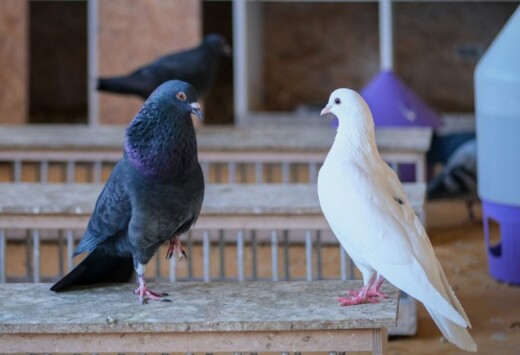
Yes. Managed pigeon lofts based on the Augsburg Model provide a sustainable and humane way to manage urban pigeon populations. The pigeons are provided with suitable food and nesting sites, while their eggs are consistently replaced with dummy eggs. This allows reproduction to be controlled directly, rather than regulating the population through hunger, displacement or culling.
Is Egg Replacement Cruel to Pigeons?
No. With egg replacement, real eggs are replaced with dummy eggs at an early stage, allowing the pigeons to continue their natural incubation behaviour. Based on current scientific knowledge, the embryo is not expected to be capable of experiencing pain at this early stage of development. At the same time, egg replacement prevents chicks from repeatedly hatching and having to grow up under poor conditions, thereby preventing suffering.
What Is the Augsburg Model?
The Augsburg Model is a humane approach to the sustainable management of urban pigeon populations. In managed pigeon lofts, the birds are provided with suitable food, safe nesting sites and medical care. Reproduction is controlled by consistently replacing their eggs with dummy eggs. At the same time, the pigeons spend a large proportion of their time in the loft, reducing droppings and conflicts over the use of public spaces.
Learn More About Urban Pigeons


Do You Have Any Other Questions?
Haven’t found what you were looking for, or is something still unclear? We’re happy to help and look forward to hearing from you. You can reach us via our contact form or at vasb@fgnqggnhora.pu.