Myths & Facts
Between Prejudice and Biology
Often dismissed as “flying rats”, urban pigeons are the subject of many misconceptions. Our fact check looks at what’s really behind some of the most common myths and assumptions.
“Urban Pigeons
Transmit Diseases”
Urban pigeons are often perceived as “rats with wings” that spread numerous dangerous diseases. Fungi, chlamydia, salmonella and parasites are frequently cited as supposed threats simply from being near the birds or their droppings.
Little Evidence of
Disease Transmission
Studies show that urban pigeons pose very little relevant risk to human health. An analysis by Kneidl-Fenske and Dammrich (2017) examined 13 commonly cited claims about diseases associated with urban pigeons. Only one was confirmed: ornithosis – and this is almost exclusively associated with poultry farming.
“Pigeon Droppings Are Dangerous
and Damage Buildings”
Pigeon droppings are widely regarded as a nuisance that corrodes façades, erodes stonework and causes lasting damage to buildings. Contact with the droppings themselves is also often perceived as a health risk. These concerns lead many cities to invest in extensive cleaning and pigeon deterrent measures.
No Significant Risk to
People or Buildings
Pigeon droppings do not pose a significant health risk to healthy people. A study by the Technical University of Darmstadt also found no damage to common building materials such as natural stone, concrete or brick. Only unprotected metals such as copper may oxidise more quickly.
“Feeding Leads to More
Urban Pigeons”
Anyone who feeds pigeons automatically causes them to produce more offspring – or so a common assumption goes. According to this view, additional food directly leads to increased breeding, which is why feeding bans are often considered the most effective way to prevent pigeon populations from growing. This assumption continues to shape many municipal approaches to urban pigeon management.
Urban Pigeons Breed Largely
Regardless of Food Availability
As a result of domestication, urban pigeons breed year-round and largely independently of food availability. Feeding bans therefore do not change their breeding behaviour, but primarily increase mortality among young pigeons and weakened adult birds. As a stand-alone measure, they are therefore ineffective, although they can be a useful complementary measure when combined with managed pigeon lofts.
“Pigeons Find Plenty
to Eat in Cities”
At first glance, cities seem to offer plenty of food for pigeons, whether in the form of discarded food, crumbs or deliberate feeding by passers-by. This often leads to the assumption that urban pigeons can easily find enough food on their own and do not need any additional support from humans.
Human Food Scraps Are Not
Suitable Food for Pigeons
As feral descendants of domesticated pigeons, urban pigeons are naturally grain-eating birds and find very little suitable food in cities. Their strong site fidelity prevents them from simply moving to more suitable environments, leaving them reliant on human food scraps. This unbalanced diet leads to nutritional deficiencies, one visible sign being the widespread – but by no means normal – watery “starvation droppings”.
“Urban Pigeons Are Wild Animals
Living in Cities”
Many people see urban pigeons as ordinary wild animals that have simply adapted to urban environments, much like foxes or raccoons. This view suggests that they can be left to fend for themselves and do not require any particular care from humans. Urban pigeons are therefore often placed in the same category as other free-living animal species that are able to survive independently in cities.
Urban Pigeons Are Homeless
Domestic Animals
Urban pigeons are not a distinct wild pigeon species, but the feral descendants of domesticated pigeons. Their strong site fidelity keeps them tied to urban environments, where they are unable to find suitable food and are forced to rely on human food waste. Thousands of years of selective breeding have also resulted in urban pigeons breeding almost year-round, which means that, unlike wild animals, their reproduction cannot be regulated through feeding bans. Sustainable solutions must therefore take their strong site fidelity and persistent breeding drive into account.
“Urban Pigeons Mate
with Wild Pigeons”
There is a common assumption that urban pigeons interbreed with native wild pigeon species such as Woodpigeons or Collared Doves, producing hybrids. Some people even assume that urban pigeons are themselves wild pigeons and can readily interbreed with other wild pigeon species. This contributes to the perception of urban pigeons as part of the native wild bird fauna, rather than as a distinct population shaped by human domestication.
No Interbreeding with
Wild Pigeon Species
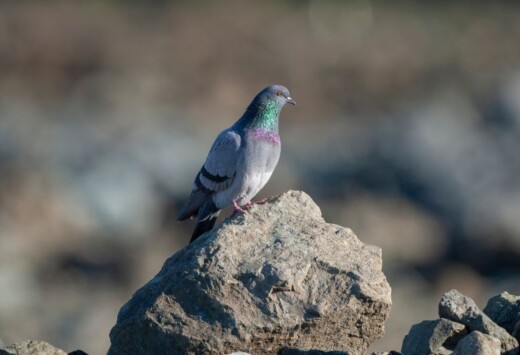
All domestic pigeon breeds, including urban pigeons, descend from the Rock Dove, which was first domesticated for practical purposes, primarily as a source of meat and fertiliser, and later bred for purposes such as carrying messages, ceremonial releases and ornamental traits. When domestic pigeon keeping was abandoned in many places during the second half of the 20th century, escaped and abandoned birds went on to establish today’s urban pigeon populations. Because of this ancestry, urban pigeons are clearly distinct from the wild pigeon species found here and do not interbreed with them.
“Culling Reduces
Pigeon Populations”
Many people assume that urban pigeon problems can be solved by deliberately killing birds: fewer pigeons, according to this logic, would automatically mean fewer offspring and a smaller population in the long term. Based on this assumption, cities and municipalities repeatedly resort to deterrence or culling campaigns. The expectation is that once pigeon numbers have been reduced, the population will remain permanently lower.
Culling Does Not Solve
the Urban Pigeon Problem
Culling campaigns are neither ethically acceptable nor effective. When part of a population is killed, the reproductive rate of the surviving birds increases (compensatory natality), meaning that the population often returns to its previous level within just a few weeks. For species such as urban pigeons, regulating reproduction is therefore considerably more effective than culling, and no study to date has demonstrated a lasting reduction in population size through culling.
“Deterrents Solve the
Urban Pigeon Problem”
Many people respond to problems involving urban pigeons with deterrent measures such as netting, spikes or wires, assuming that these will permanently keep the birds away from certain locations or drive them away altogether. The expectation is that if pigeons are displaced from one location, the underlying problems associated with the population will disappear as well.
Displacement,
Not a Solution
Deterrent measures such as spikes, netting, metal grilles or structural barriers are of limited value when used on their own. They are costly and can result in injury or death. Their effectiveness depends on how motivated the birds are to overcome the obstacles – and pigeons can be remarkably resourceful in doing so. Moreover, these measures merely shift the problem elsewhere, addressing the symptoms rather than the underlying cause.
“Pigeon Lofts Attract
Additional Pigeons”
Many people worry that managed pigeon lofts will attract additional pigeons from the surrounding area and actually cause the population to increase. The idea is that an attractive, protected place with food and nesting opportunities will act like a magnet for pigeons flying around the area, making the problem worse rather than solving it.
Managed Pigeon Lofts Reduce
Populations in the Long Term
Managed pigeon lofts based on the Augsburg Model follow the principle of humane population management. The lofts are strategically established at urban pigeon hotspots to encourage pigeons already living in the area to settle there by providing suitable food and nesting opportunities. Population management is achieved through regular egg replacement: fresh eggs are replaced with dummy eggs, preventing offspring from hatching without harming the parent birds. In this way, managed pigeon lofts do not increase pigeon numbers but reduce them over the long term.