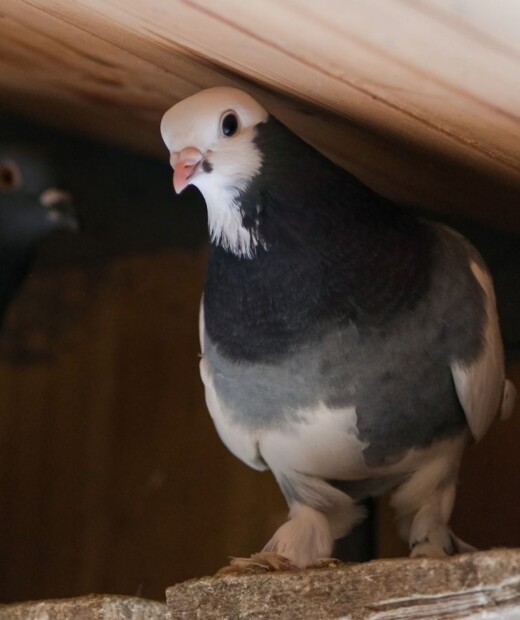
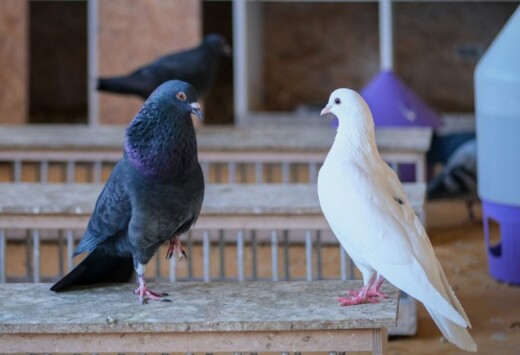
To find a sustainable solution to the challenges associated with urban pigeons, it is essential to understand their causes and consequences. Many of the measures used to date address conflicts where they become visible, without adequately considering the underlying factors.
A Human-Made Problem
As descendants of domesticated and racing pigeons, urban pigeons carry traits that were selectively bred by humans over thousands of years: they show strong site fidelity, use buildings as nesting sites and breed almost year-round. Unlike native wild pigeon species, they are therefore strongly dependent on urban environments and the resources available there.
Urban pigeons are clearly distinct from the wild pigeon species found here, such as Woodpigeons and Stock Doves, and are therefore biologically classified as domestic pigeons.
For the pigeons, consequences are severe: As naturally grain-eating birds, they find little suitable food in cities and instead feed on human food scraps and waste, which can seriously affect their health and is also reflected in the watery “starvation droppings” they produce. Their constant search for food on the ground exposes them to further hazards: threads and human hair can become wrapped around their feet, causing severe constriction injuries.
Their selectively bred drive to reproduce further exacerbates the situation: even under poor conditions, urban pigeons breed year-round, resulting in high mortality, particularly among young pigeons.
Measures with Limited Effectiveness
Spikes, netting and other deterrent systems can keep pigeons away from specific areas, but they do not address the underlying problem. Because urban pigeons show strong site fidelity, they usually move to nearby buildings and niches instead; improperly installed deterrents can also cause serious injuries.
Other approaches to population management also have limitations: Sterilising individual birds is labour-intensive, costly and carries significant risks for the animals. Oral contraceptives such as Ovistop, on the other hand, must be administered continuously and under controlled conditions, raising questions about dosage, side effects and potential impacts on other animal species.
Killing urban pigeons is also used as a means of population control, but it does not address the underlying causes. When birds are removed from a population, nesting sites and food sources remain available. At the same time, the remaining birds can partially compensate for these losses through increased reproduction (“compensatory natality”).
In addition, pigeons that are killed may be parent birds, leaving chicks in the nest without care. For long-term population management, it is therefore not only more humane but also more effective to control reproduction in a targeted way rather than killing existing birds.
Feeding bans aim to regulate pigeon populations by reducing the availability of food. Unlike many wild animals, however, the breeding behaviour of urban pigeons cannot simply be controlled through food availability: because of their selectively bred strong reproductive drive, they continue to breed even when food is severely limited. Studies show that young pigeons continue to hatch, while their chances of survival are significantly reduced by the lack of food.
From an animal welfare perspective, this is precisely the problem: population control is not achieved by deliberately preventing reproduction, but through hunger and increased mortality. As a stand-alone strategy, feeding bans are not a humane form of population control.
Deterrents, culling and feeding bans address the urban pigeon problem where it becomes visible, but do not change its underlying causes.
A sustainable solution must therefore address reproduction, access to appropriate food and nesting sites. Rather than tackling individual symptoms, effective urban pigeon management must take into account the needs of both the birds and the people who share their environment. This is precisely the approach taken by managed pigeon lofts based on the Augsburg Model.