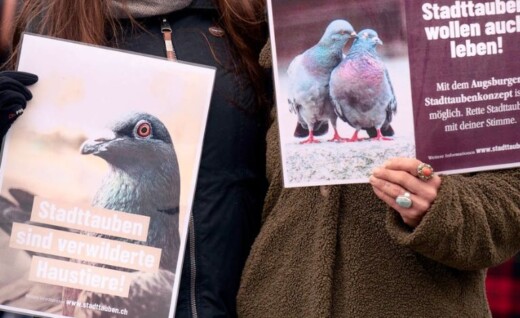
The Augsburg Model in Switzerland
Urban Pigeon Management in Winterthur
While Zurich and Basel continue to debate how best to manage urban pigeons, Winterthur has been taking a different approach for years. An in-depth report by the Neue Zürcher Zeitung (NZZ) on 23 May 2025 brought Winterthur’s pigeon management programme to national attention – and showed how managed pigeon lofts work in practice.
Two Managed Pigeon Lofts in the Heart of the City
Winterthur operates two managed pigeon lofts close to the railway station. The larger is located in the attic of an old industrial building and provides space for around 100 to 120 pigeons. The lofts are managed by the city’s pigeon caretaker, Sandra Schenk, who cleans the facilities, provides the birds with suitable grain-based food and regularly checks their nests.
The approach is based on the Augsburg Model: pigeons are encouraged to settle in suitable managed lofts, where they are provided with controlled feeding and their freshly laid eggs are swapped for dummy eggs. This allows their reproduction to be managed without killing the birds. At the same time, a large proportion of their droppings remains inside the loft rather than in public spaces. According to the NZZ, Sandra Schenk swapped more than 300 pigeon eggs in 2024 alone.
Feeding Is Part of the Approach
The NZZ report highlights an important point: a managed pigeon loft does not work through egg swapping alone. The pigeons also need a reason to spend time there.
In Winterthur, they are therefore provided with a specially formulated grain mix every day, while continuing to find some of their food outside the lofts. Controlled feeding not only contributes to the pigeons’ welfare but also helps encourage them to remain attached to the managed sites.
This is particularly noteworthy in Switzerland. Zurich’s 2023 hunting legislation made feeding free-living animals generally punishable and nearly affected Winterthur’s pigeon lofts as well. However, the city’s Civil Engineering Office applied for an exemption and was granted one.
Urban Pigeons Are Not Ordinary Wild Animals
The NZZ article also addresses a fundamental question: what exactly are urban pigeons, both legally and biologically?
Urban pigeons descend from the Rock Dove but have been domesticated and selectively bred by humans over thousands of years. Although they now live freely in our cities, they still retain traits shaped by this history of domestication. In the article, Sibel Konyo of the Foundation for the Animal in the Law (TIR) therefore criticises their current legal status and argues that urban pigeons should consistently be treated as domesticated animals.
This distinction is crucial to the political debate. If urban pigeons are viewed simply as wild animals, feeding bans and deterrence can quickly appear to be obvious solutions. Taking their history of domestication into account, however, also raises questions about appropriate care and responsible population management.
Healthy Pigeons Instead of a “Pigeon Problem”
The report also highlights an important connection when it comes to the pigeons’ health. Sandra Schenk explains that pigeons provided with suitable grain-based food produce firm droppings. Birds that rely on unsuitable foods such as bread, chips or discarded human food, by contrast, are more likely to suffer from diarrhoea. Controlled, appropriate feeding can therefore improve not only the pigeons’ health but also help reduce soiling in public spaces.
Winterthur demonstrates that animal welfare and the interests of a city do not have to be in conflict.
A Swiss Example with Wider Relevance
Winterthur has not addressed its urban pigeon population by starving, displacing or killing the birds. Instead, the city has taken responsibility and created infrastructure that combines appropriate care with population management.
Hermann Steiner, who is responsible for the project, also gives the programme a positive assessment in the NZZ. Its success, however, depends on people who are willing to manage the pigeon lofts reliably over the long term, as well as a city prepared to provide the necessary funding. Schenk and Steiner also report that they have already shared their experience with other cities.
This is what makes the Winterthur example so significant: the Augsburg Model is not merely a German concept. It has also been put into practice successfully in a Swiss city for years. Winterthur shows that managed pigeon lofts, appropriate feeding and egg swapping can work under Swiss conditions – provided there is the political will to make them happen.

Our comprehensive guide is based on the Augsburg Model and shows how managed pigeon lofts can be implemented efficiently and humanely in Switzerland.